Falls
The Box Rig
- Manages
- Kinetic energy at landing
- Turns it into
- Speed into a metre of crush
- In the hands of
- Rigging carpenters

Cardboard does something foam cannot: it gives way in one direction, holds in every other, and keeps doing that until it has nothing left to give.
What the Rig Actually Is
Long before airbags, long before the engineered mat stacks that now dominate high-fall preparation, stunt performers landed in cardboard. Not loosely piled boxes—the term "box rig" describes a specific, densely packed arrangement of corrugated cardboard cartons, stacked and oriented so their cells run vertically. The performer falls into the top surface, and those cells begin to collapse progressively downward, each rank of corrugation yielding a little before the next. The stop is spread across the full depth of the stack rather than delivered all at once at the bottom.
The physics are straightforward. A fall accumulates kinetic energy in proportion to the distance dropped and the performer's weight. The job of any landing surface is to dissipate that energy over as much time—and therefore as much distance—as possible before velocity reaches zero. A hard floor does this in milliseconds. A correctly built box rig might take a hundred milliseconds or more, and a hundred milliseconds of deceleration distributed across a metre of crush is a force the body can survive repeatedly.
What cardboard offers that foam does not is predictable, directional failure. Corrugated cells hold against sideways loads and crush progressively when compressed along their vertical axis. Lateral forces—the kind that would roll or tumble a performer—are resisted rather than accommodated. Foam, by contrast, can deform in any direction; it can shear, it can push material sideways, it can produce an angled deceleration path. A box rig stays roughly where it is built. The performer goes straight through it.
How It Gets Built
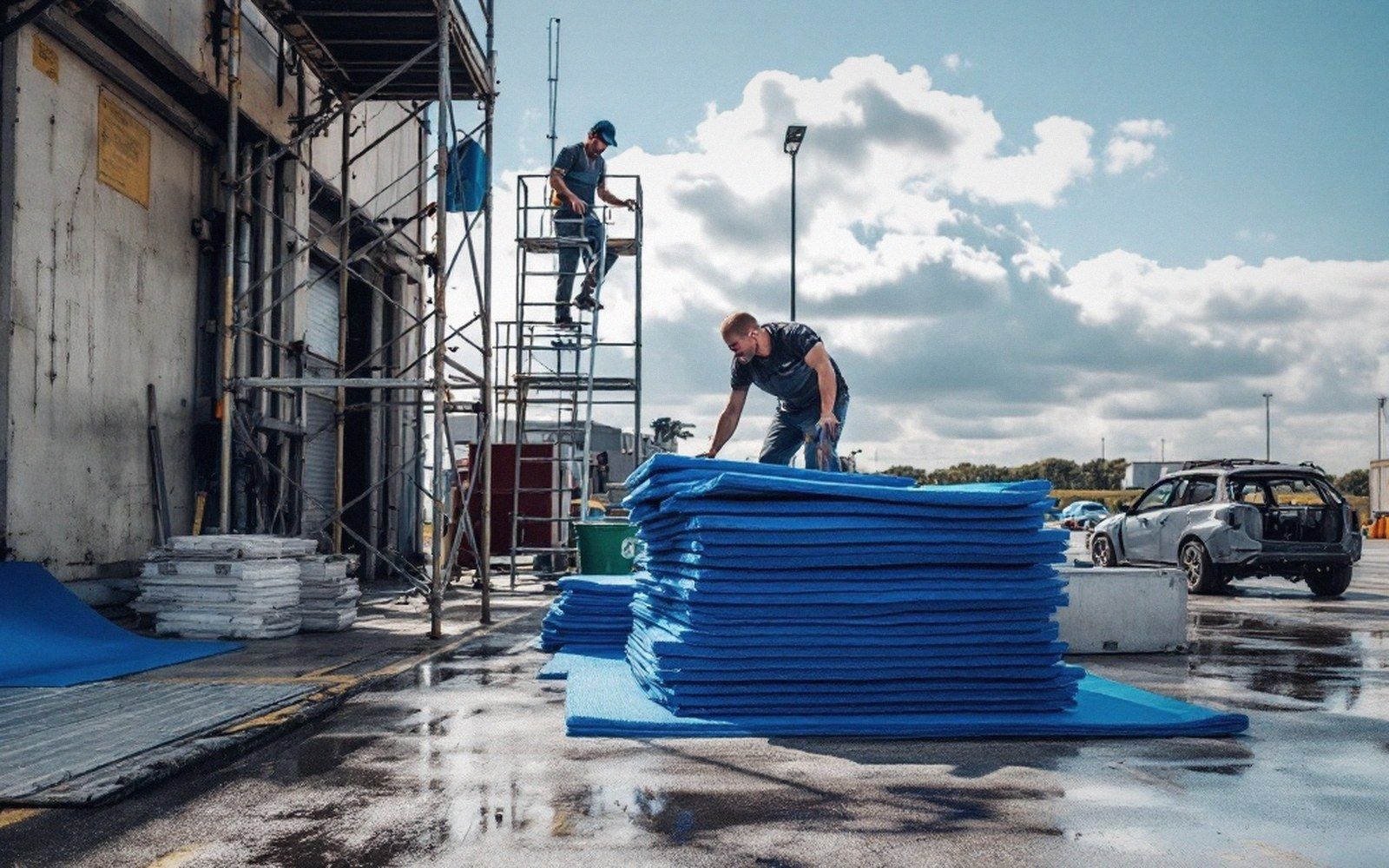
The word "built" is intentional. A box rig is constructed, not assembled. Carton size and wall thickness are chosen to match the expected impact: heavier performers and greater falls require denser material; a thin-walled grocery carton would collapse too quickly and bottom out. The boxes are packed tightly enough that they cannot tip or migrate, and the stack is typically tiered—a softer upper zone that accepts the initial contact, a progressively denser middle that does most of the decelerating work, a firm lower section that arrests the last of the motion without sudden hardness. Getting that gradient right is the coordinator's calculation, and it gets tested before a performer enters the picture.
Testing means drop-testing: weighted bags, increasing mass, the same fall multiple times until the crush profile is understood. This is technical work carried out by experienced stunt coordinators and riggers who know what a rig that bottoms out looks like versus one with the correct margin of remaining depth. The rig is rebuilt or adjusted after each meaningful test, and often after each take, because a crushed box is a spent box—the cellular structure that did the decelerating work is now flat and offers almost nothing the next time. Box rigs are single-use in sections, and that replacement discipline is part of the protocol, not an afterthought.
From the build
What the material does
Why It Is Still Used
Modern foam pits and airbag systems have largely displaced the box rig for high falls on larger productions with the budget and the prep time those systems require. But the box rig has not disappeared, and its continued presence on set is not nostalgia. Several things keep it in use.
First, cost and logistics. Cardboard is cheap, widely available, and disposable without special handling. A rigger can source material locally, cut it to spec, and build a usable rig in a fraction of the time a custom airbag requires. For lower-budget productions, for inserts and pick-up shots, for falls of moderate height where a full airbag system would be engineering overhead for a modest gag, the box rig is genuinely the right tool.
Second, the surface. An airbag has a skin tension that can affect the way a performer's body enters it; a foam pit has a surface that moves. Cardboard has almost none of that. Entry is clean, predictable, and quiet enough to shoot with practical sound if needed. The camera does not see a performer plunging into an obvious safety device—it sees the performer hit a surface that immediately disappears beneath them.
Third, sight lines. A box rig can be dressed. The cartons can be painted, covered with breakaway material, integrated into a set so that the reveal of what's beneath the performer happens at the same moment the take ends. The rig is doing its engineering work invisibly, which is precisely what the best safety apparatus always does.
The technology is old. The paper cellular structure that makes corrugated cardboard useful for shipping also makes it useful for this. Sometimes the unglamorous solution is the one that has already been validated by every coordinator who ever trusted a fall to it, and kept working.
From the build